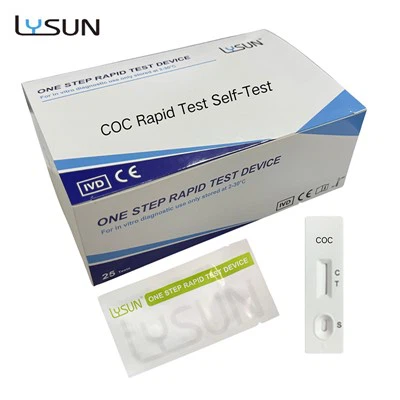

Hey there! As a supplier of THC Test Kits, I know how crucial it is to ensure the accuracy of these kits. Whether you're a law enforcement agency, a workplace administrator, or just someone concerned about drug use, you rely on these tests to give you reliable results. So, let's dive into how I make sure our THC Test Kit is as accurate as possible.
Understanding the Basics of THC Testing
First things first, it's important to understand what THC is and how it's detected. THC, or tetrahydrocannabinol, is the main psychoactive compound in cannabis. When someone uses cannabis, THC is absorbed into the bloodstream and then metabolized by the body. The metabolites, such as THC-COOH, can be detected in various biological samples like urine, saliva, and hair.
Our THC Test Kits are designed to detect these metabolites in urine samples. They work based on the principle of immunoassay, which is a biochemical test that uses antibodies to detect specific substances. In our case, the antibodies in the test kit are designed to bind to THC metabolites. If the metabolites are present in the urine sample, they will bind to the antibodies, causing a visible reaction on the test strip.
Quality Control in Manufacturing
One of the most important steps in ensuring the accuracy of our THC Test Kits is strict quality control during the manufacturing process. We follow Good Manufacturing Practices (GMP), which are a set of regulations that ensure the quality, safety, and effectiveness of medical devices and diagnostic products.


We start by sourcing high-quality raw materials. The antibodies used in our test kits are carefully selected and tested to ensure their specificity and sensitivity. Specificity refers to the ability of the antibodies to bind only to THC metabolites and not to other substances that might be present in the urine sample. Sensitivity, on the other hand, refers to the ability of the antibodies to detect even small amounts of THC metabolites.
During the manufacturing process, we perform multiple quality checks at every stage. We test the test strips for proper assembly, the accuracy of the reagent dispensing, and the stability of the chemical reactions. We also conduct batch testing on a regular basis to ensure that each batch of test kits meets our quality standards.
Calibration and Validation
Another key aspect of ensuring accuracy is calibration and validation. Calibration involves adjusting the test kit to ensure that it gives accurate results within a specific range. We use reference materials with known concentrations of THC metabolites to calibrate our test kits. These reference materials are traceable to international standards, which means that the results obtained from our test kits can be compared to results from other reliable testing methods.
Validation is the process of demonstrating that the test kit performs as intended under specific conditions. We conduct validation studies in our laboratory using a large number of urine samples with known THC metabolite concentrations. These studies include testing the accuracy, precision, sensitivity, and specificity of the test kit. We also evaluate the performance of the test kit in different environmental conditions, such as temperature and humidity, to ensure that it gives consistent results.
Training and Education
We also provide training and education to our customers to ensure that they use our THC Test Kits correctly. Using the test kit incorrectly can lead to inaccurate results. We provide detailed instructions with each test kit, including how to collect the urine sample, how to perform the test, and how to interpret the results.
We also offer training programs for our customers, especially for those who are using the test kits in a professional setting. These training programs cover topics such as sample collection, test kit operation, quality control, and result interpretation. By ensuring that our customers are well-trained, we can minimize the risk of human error and improve the accuracy of the test results.
Continuous Improvement
The field of THC testing is constantly evolving, and we are committed to continuous improvement. We stay up-to-date with the latest research and technological advancements in the field. We also collect feedback from our customers and use it to improve our test kits.
For example, if we receive feedback that a particular aspect of the test kit is difficult to use, we will work on improving the design or the instructions. If there are new developments in the detection of THC metabolites, we will incorporate these advancements into our test kits to improve their accuracy and performance.
The Importance of THC Rapid Tests
In addition to our standard THC Test Kits, we also offer THC Rapid Tests. These tests are designed to give quick results, usually within a few minutes. They are especially useful in situations where immediate results are needed, such as in a workplace or a law enforcement setting.
The accuracy of our THC Rapid Tests is also a top priority. We use the same high-quality materials and manufacturing processes as our standard test kits. The rapid tests are also calibrated and validated to ensure that they give accurate results. However, it's important to note that rapid tests are generally less sensitive than laboratory-based tests. They are designed to give a quick indication of the presence of THC metabolites, but if a more accurate measurement is needed, a confirmatory test using a laboratory-based method may be required.
Conclusion
Ensuring the accuracy of our THC Test Kits is a multi-faceted process that involves quality control in manufacturing, calibration and validation, training and education, and continuous improvement. By following these steps, we can provide our customers with reliable and accurate test kits that they can trust.
If you're interested in purchasing our THC Test Kits or have any questions about their accuracy or performance, please don't hesitate to contact us. We're here to help you find the right testing solution for your needs.
References
- World Health Organization. (2023). Good Manufacturing Practices for Medical Devices.
- International Organization for Standardization. (2023). ISO 13485: Medical Devices - Quality Management Systems - Requirements for Regulatory Purposes.
- National Institute on Drug Abuse. (2023). Marijuana DrugFacts.