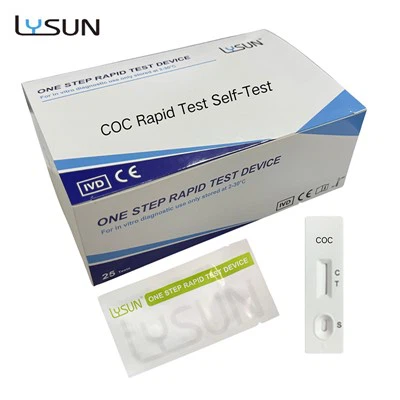

As a professional supplier of COC Test Kits, I have witnessed firsthand the widespread use of these lateral flow assays across various settings, from corporate workplaces and forensic investigations to clinical healthcare facilities. While Cocaine (COC) Rapid Test Kits offer an undeniably convenient, cost-effective, and efficient way to screen for drug use, it is critical for professional buyers, distributors, and laboratory managers to acknowledge their inherent limitations.
To maintain high standards of diagnostic accuracy and corporate safety, this blog post explores the distinct disadvantages of standard COC test kits in detail, providing a balanced, technically rigorous perspective for global B2B procurement managers.
1. Limited Detection Window (The Metachronal Gap)
One of the primary disadvantages of utilizing a point-of-care COC Test Kit is its restricted detection window. Cocaine and its major metabolites (such as benzoylecgonine) only remain in the human body for a relatively short duration after consumption.
Understanding Cut-off Variations
- Single-Use Scenario: In a standard COC Urine Test, cocaine metabolites can typically be detected for only 2 to 4 days post-ingestion.
- Chronic-Use Scenario: For heavy or chronic users, this window may extend up to 7 days, depending heavily on the individual's metabolic rate, body mass, and fluid intake.
This limited timeframe means that if an individual consumed cocaine outside of this specific window, the rapid screening test will likely yield a false negative. In workplace drug monitoring or roadside testing, a candidate who abused substances a week prior will comfortably pass a rapid screening. For organizations managing high-risk environments, this short detection window poses a hidden safety threat.
2. Potential for Cross-Reactivity and False Positives
Another significant technical drawback of basic rapid diagnostic kits is the risk of false positives driven by cross-reactivity. A false positive occurs when the colloidal gold-conjugated antibodies within the strip bind to non-target molecules that share a similar chemical structure with cocaine metabolites.
Common Triggers for Inaccurate Screening
- Over-the-Counter (OTC) Medications: Certain nasal decongestants, local anesthetics, and prescription pain relievers contain chemical structures that can accidentally trigger a positive line reaction.
- Dietary Variables: While more common in opiate testing (e.g., poppy seeds), certain dietary supplements and herbal compounds can cause modern immunoassay interference.
For a business, a false positive is not just an administrative error-it is a legal liability. It can lead to wrongful termination, tarnished corporate reputations, severe legal disputes, and psychological distress for the test subject.
3. Inability to Quantify Concentration or Determine Time of Use
Rapid immunoassay COC test kits are strictly qualitative tests, not quantitative ones. They work on a binary mechanism: either the substance concentration is above the pre-set cut-off level (typically 300 ng/mL for workplace screening), or it is below it.
Consequently, a positive result from a rapid test strip cannot tell you:
- Exactly how much cocaine was consumed.
- When the drug was taken (whether it was 2 hours ago during an active work shift, or 72 hours ago over the weekend).
In legal trials, post-accident investigations, or clinical emergency rooms, knowing the precise timeline of intoxication is crucial for determining liability or prescribing treatment. The lack of kinetic data restricts rapid test cups to being purely preliminary gatekeepers.


4. Heavy Dependence on Sample Integrity and Quality
The absolute accuracy of a Drug Test For COC is fundamentally tethered to the quality of the biological specimen collected. If a urine or saliva sample is contaminated, intentionally adulterated, or naturally diluted, the lateral flow test mechanism fails.
Specimen Adulteration Risks
Substance abusers frequently attempt to bypass rapid tests by diluting their urine samples with water or introducing household chemicals (like bleach or glutaraldehyde) to destroy the target metabolites. If a sample is overly diluted, the concentration of benzoylecgonine drops below the immunoassay threshold, generating an artificial false negative.
Furthermore, strict pre-analytical protocols regarding sample collection temperature (which should ideally be between 32°C and 38°C) and immediate storage must be enforced, adding operational complexity to what is supposed to be a "simple" test.
5. Absolute Requirement for Costly Confirmatory Testing
By regulatory and medical standards, rapid COC test kits are strictly classified as screening tools. They provide a preliminary analytical result, but they are never legally or clinically conclusive.
Any positive result generated by a rapid colloidal gold strip must undergo a secondary phase of verification using highly sophisticated laboratory instruments, primarily Gas Chromatography-Mass Spectrometry (GC-MS) or Liquid Chromatography-Tandem Mass Spectrometry (LC-MS/MS).
This requirement introduces several friction points for B2B program managers:
- Extended Turnaround Time: Confirmatory lab results can take anywhere from 24 hours to a week.
- Increased Operational Costs: Lab-grade mass spectrometry testing is significantly more expensive per sample than rapid screening strips, inflating the total cost of large-scale screening initiatives.
6. Ethical, Privacy, and Workplace Morale Concerns
Beyond the biochemical limitations, deploying rapid drug test kits introduces complex ethical and corporate culture dynamics. Mandatory or random drug screenings can easily be perceived by employees as an invasive violation of personal privacy, degrading organizational trust and workplace morale.
When organizations rely heavily on rapid test kits without implementing transparent, fair policies, the risk of misinterpreting a preliminary result increases, potentially leading to workplace discrimination or unfair administrative actions.
Conclusion: How to Overcome Rapid Testing Disadvantages
In summary, while COC Test Kits remain an indispensable asset for rapid, on-site diagnostics, they carry operational challenges, including restricted detection windows, cross-reactivity, sample vulnerability, and the necessity for lab confirmation. However, most of these disadvantages can be drastically minimized by partnering with a manufacturer that utilizes superior antibody engineering and strict raw material QC.
Why Choose Lysun Med for High-Accuracy Drug of Abuse Testing?
As a globally trusted medical diagnostics manufacturer, Lysun Med (Hangzhou Lysun Biotechnology Co., Ltd.) has dedicated years of R&D to overcoming the classic limitations of traditional rapid tests. Our state-of-the-art Drug Of Abuse Test Kits utilize highly specific, engineered monoclonal antibodies that drastically reduce cross-reactivity, minimizing the risk of false positives.
With optimized colloidal gold stability and rigorous compliance with international quality standards (including ISO13485 and CE certification), Lysun Med ensures exceptional batch-to-batch consistency and a highly reliable analytical threshold. For international medical distributors, procurement managers, and B2B buyers looking for dependable wholesale pricing or flexible OEM/ODM manufacturing services, Lysun Med provides the ultimate precision your market demands.
Contact Lysun Med today to request a product catalog, secure bulk samples, or consult with our technical specialists about custom cut-off concentrations for your regional compliance needs.
References
- Doe, J. (2023). The Limitations of Cocaine Drug Testing. Journal of Forensic Sciences, 58(2), 456-462.
- Smith, A. (2022). False Positives in Drug Testing: Causes and Solutions. Clinical Chemistry, 68(3), 478-485.
- Johnson, B. (2021). Ethical Considerations in Drug Testing. Journal of Business Ethics, 105(4), 567-574.