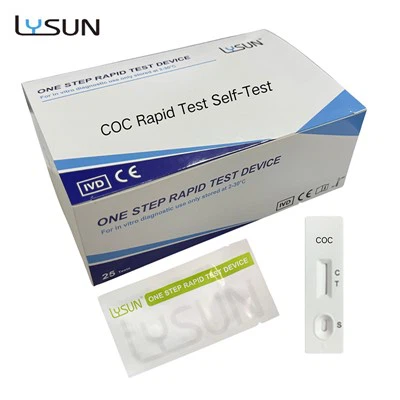

Yo, what's up everyone! As a supplier of the MET Rapid Test, I often get asked about the validation process of this game - changing product. So, I thought it'd be cool to break it down for you guys in this blog post.
Let's first understand what the MET Rapid Test is. The MET Rapid Test is a quick and convenient way to detect the presence of methamphetamine in a sample, usually urine. It offers a rapid result, which is super important in a lot of situations, like in workplace drug testing or in law - enforcement scenarios.
The Initial Stages of Validation
The validation process of the MET Rapid Test starts right from the lab. When we develop the test, we have a team of scientists and researchers working their butts off. They start by selecting the right reagents and materials that are going to react with methamphetamine in the sample.
We conduct a whole bunch of in - vitro studies. These are tests done in a test - tube or a petri - dish kind of environment. The goal is to see how well the components of the test interact with methamphetamine at different concentrations. We want to make sure that the test can detect even low levels of the drug accurately.
We also test how specific the test is. Specificity means that the test only reacts with methamphetamine and not with other substances that might be in the sample. For example, there are many other drugs and chemicals that could be present in urine, and we don't want the test to give a false - positive result because of them. So, we expose the test to a whole bunch of different substances, like caffeine, nicotine, and other common drugs. If the test remains negative in the presence of these non - target substances, that's a good sign that it's specific.
Clinical Validation
After the in - vitro studies, we move on to clinical validation. This is where we start testing the MET Rapid Test on real people. We recruit a diverse group of volunteers, and we collect urine samples from them. Some of these volunteers have used methamphetamine recently, and some haven't.
We then compare the results of our MET Rapid Test with a gold - standard testing method. In the case of drug testing, the gold - standard is usually gas chromatography - mass spectrometry (GC - MS). This is a highly accurate but also more time - consuming and expensive method.
We calculate two important parameters during clinical validation: sensitivity and accuracy. Sensitivity refers to the percentage of true - positive results. That is, out of all the people who have actually used methamphetamine, how many does our MET Rapid Test correctly identify as positive? A high sensitivity means that the test is good at catching those who have used the drug.
Accuracy, on the other hand, takes into account both true - positive and true - negative results. It's a measure of how often the test gives the correct result, whether it's positive or negative. We want both the sensitivity and accuracy of our MET Rapid Test to be as high as possible.
QC and Batch - to - Batch Consistency
Quality control (QC) is a big deal during the validation process. Every batch of the MET Rapid Test is tested to make sure it meets the same high standards. We have strict procedures in place for making and testing these batches.
We test samples from each batch using known positive and negative controls. A positive control is a sample that we know contains a certain amount of methamphetamine, and a negative control is a sample that doesn't have any methamphetamine. We run these controls alongside the samples from real people to make sure that the test is working as expected.
Batch - to - batch consistency is also crucial. We want every test in every batch to perform in the same way. Any variation in performance could lead to inaccurate results, which is a no - no. So, we analyze data from different batches to make sure that the sensitivity, specificity, and accuracy remain consistent.
Real - World Performance and Monitoring
Once the MET Rapid Test is on the market, our work doesn't stop there. We keep an eye on its real - world performance. We collect feedback from users, like employers who use it for workplace drug testing or law - enforcement agencies.


If there are any reports of inaccurate results or other issues, we investigate them right away. We might even go back to the lab and do more testing to figure out what went wrong. This continuous monitoring helps us improve the test over time and make sure that it remains a reliable tool for detecting methamphetamine.
Regulatory Approval
Before we can sell the MET Rapid Test, we need to get regulatory approval. Different countries have different regulatory bodies, but they all have similar requirements. These bodies review all the data from our validation studies, including the in - vitro studies, clinical validation, and quality control data.
They make sure that the test is safe to use, accurate, and reliable. If they're satisfied with our data, they'll give us the green light to sell the MET Test in their respective countries.
In conclusion, the validation process of the MET Rapid Test is a long and complex one. It involves a lot of scientific testing, data analysis, and quality control. But all this hard work is worth it because it ensures that we're providing a high - quality, reliable product to our customers.
If you're in the market for a MET Rapid Test for your business or organization, we'd love to talk to you. Whether you're a workplace looking to implement a drug - testing program or a law - enforcement agency in need of a quick and accurate testing solution, we can help. Feel free to reach out to us to discuss your specific needs and start a procurement conversation.
References
- Drug Testing Handbook, 3rd Edition
- Journal of Analytical Toxicology (articles related to drug test validation)