


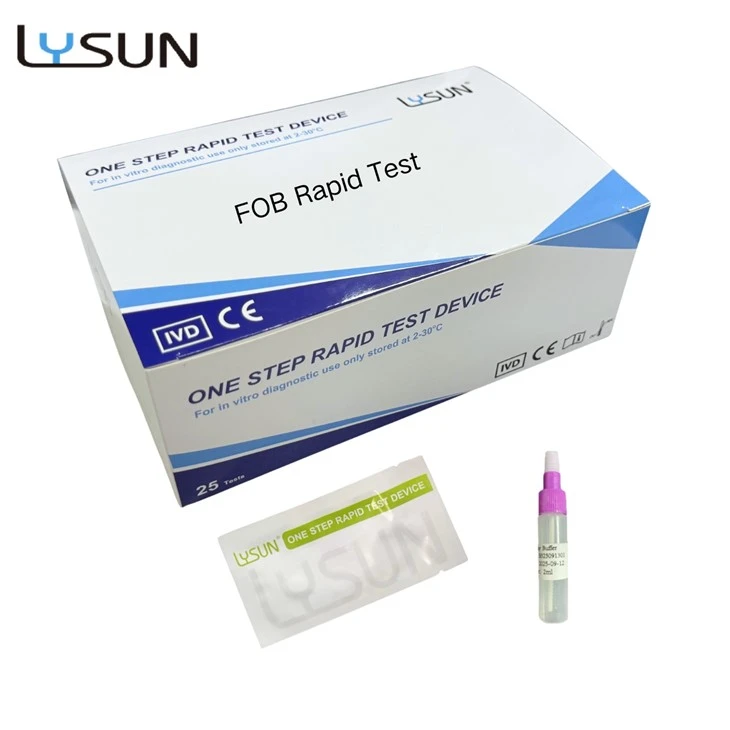
FOB Pathology Test is primarily used as an early screening tool to detect signs of colorectal cancer or other digestive tract issues like polyps, ulcers, and hemorrhoids.


|
Product name |
FOB Rapid Test |
|
Item type |
FOB-F11, FOB-F21 |
|
Specimens |
Feces |
|
Test Time |
Waiting about 15 minutes |
|
Certificate |
CE, ISO:13485 |
|
OEM |
Acceptable |
|
Storage condition |
The kit should be stored at 2-30°C |
STORAGE AND STABILITY
- The kit should be stored at 2‐30°C until the expiry date printed on the sealed pouch.
- The test must remain in the sealed pouch until use.
- Do not freeze.
- Cares should be taken to protect components in this kit from contamination. Do not use if there is evidence of microbial contamination or precipitation. Biological contamination of dispensing equipments, containers or reagents can lead to false results.
SPECIMEN COLLECTION AND STORAGE
The Fecal Occult Blood (FOB) Rapid Test is intended only for use with human fecal specimens.
- Patients should not collect samples during or within 3 days of their menstrual period, if they have bleeding hemorrhoids, blood in the urine,or if they have strained during bowel movement.
- Alcohol, aspirin and other medications taken in excess may cause gastrointestinal irritation resulting in occult bleeding. Such substances should be discontinued at least 48 hours prior to testing.
- No dietary restrictions are necessary before testing.
- Perform the testing immediately after the specimen collection. Do not leave the specimens at room temperature for prolonged periods. Specimens maybe stored at 2‐8°C for up to 72 hours.
- Bring specimens to room temperature prior to testing.
- Pack the specimens in compliance with applicable regulations for transportation of etiological agents, in case they need to be shipped.
FAQ
Q: Is the FOBT test as good as colonoscopy?
A: For catching colorectal cancer, an FOBT (or the modern, more accurate FIT) done annually is just as effective at reducing mortality as a colonoscopy. However, it is not as comprehensive, because it cannot prevent cancer by finding and removing precancerous polyps like a colonoscopy does.
Q: What not to eat before a FOBT test?
A: Before the test your healthcare professional may ask you to avoid:
Certain fruits and vegetables.
Rare red meat.
Certain vitamin supplements, such as vitamin C and iron.
Pain relievers, such as aspirin and ibuprofen (Advil, Motrin IB and others).
Q: What is the next step after a positive FOB?
A: You need to have a colonoscopy.
Colonoscopy should be done within 30 days of receiving a positive FOBT result. A positive FOBT does not necessarily mean that you have bowel cancer, but it is essential that you have a colonoscopy to investigate the cause of the bleeding.
Q: Should I be worried about a positive stool test?
A: A positive stool test (such as a FIT or Cologuard test) simply means hidden blood or altered DNA was found, but it does not automatically mean you have cancer. Most positive results are caused by common, benign issues like hemorrhoids, ulcers, polyps, or inflammation.
Q: How much stool is needed for FOB?
A: Collect 1 to 3 fecal samples from separate bowel movements, depending on the specific test ordered by your provider. The number of samples varies by kit.
Q: Can I drink coffee before a stool test?
A: Whether or not you can drink coffee before a stool test depends entirely on the specific test your doctor ordered. Many tests require no fasting, but coffee should be avoided if you are specifically testing for fecal occult blood (to avoid gastrointestinal irritation) or if your test is combined with blood work.
Q: What can cause a false positive FOB test?
A: A false-positive fecal occult blood test (FOBT) occurs when the test detects blood in your stool, but the bleeding is from a benign source, dietary interference, or sample contamination rather than conditions like polyps or cancer.
Hot Tags: fob pathology test, China fob pathology test manufacturers, suppliers, factory, fob rapid test, Home FOB Test, tumor markers test


