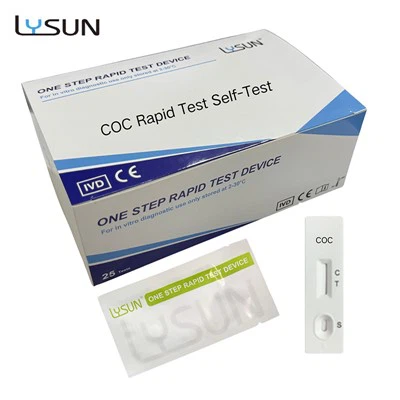

As a supplier of the MET Rapid Test, I am often asked about its performance across different age groups. Understanding these differences is crucial, as it allows healthcare providers to make informed decisions and ensures the users can rely on the test results.


Introduction to the MET Rapid Test
First, let's briefly introduce the MET Rapid Test. The MET Rapid Test is a reliable and efficient tool designed to detect methamphetamine in urine samples. It provides fast and accurate results, making it a popular choice in drug testing scenarios, including workplace screening, law - enforcement actions, and rehabilitation centers. The test operates on a simple principle of immunochromatography. Antibodies on the test strip bind to methamphetamine molecules in the urine if present, producing visible lines that indicate the test result.
Performance in Children and Adolescents
When it comes to children and adolescents (ages typically considered from 6 - 19 years), the physiological characteristics of their bodies can have an impact on the performance of the MET Rapid Test.
From a physiological perspective, children and adolescents are still in the process of growth and development. Their metabolism may be faster compared to adults in many cases. This means that methamphetamine, if consumed, might be metabolized and excreted more quickly from their systems. As a result, if the test is conducted too long after consumption, there could be a false - negative result. For instance, some studies have shown that in cases where children or adolescents have had a single, low - dose exposure to methamphetamine, the metabolite levels in their urine could drop below the detectable limit of the MET Test within 24 - 36 hours, while in adults, it may remain detectable for up to 72 hours.
However, if the test is administered within the appropriate time frame, the MET Rapid Test generally performs well in this age group. The reagent strip's sensitivity and specificity remain stable, as long as there are sufficient levels of methamphetamine or its metabolites in the urine sample. It is important to note that methamphetamine use among children and adolescents is relatively rare but can have severe consequences for their health and development. Therefore, when using the MET Rapid Test in this age group, it should be part of a comprehensive assessment that also includes psychological and behavioral evaluations.
Performance in Young Adults
Young adults (ages 20 - 39 years) form a significant demographic in drug use studies. This is a period when individuals may be more likely to experiment with various substances, and methamphetamine use is unfortunately on the rise in this age category.
The physiological state of young adults is typically characterized by a relatively stable metabolism, although it can vary depending on lifestyle factors such as diet, exercise, and stress levels. In general, the MET Rapid Test shows high accuracy in young adults. The test's sensitivity, which refers to the ability to correctly identify positive cases, is often above 95%. This means that in most cases where a young adult has used methamphetamine, the test will accurately detect it.
The specificity, which is the ability to correctly identify negative cases, is also high, usually around 98%. This implies that false - positive results are rare. However, factors such as cross - reactivity with certain medications or substances can still occur. Some medications used to treat attention - deficit/hyperactivity disorder (ADHD) contain stimulants that may cause a false - positive reaction in the MET Rapid Test. In such cases, confirmatory tests using more advanced technologies like gas chromatography - mass spectrometry (GC - MS) are recommended.
Performance in Middle - aged Adults
Middle - aged adults (ages 40 - 59 years) have a different set of physiological changes compared to younger age groups. As people age, their metabolic rate gradually slows down. This can have implications for the detection of methamphetamine in the MET Rapid Test.
Since methamphetamine and its metabolites are excreted more slowly in middle - aged adults, the test may be able to detect the drug for a longer period after consumption. This can be an advantage in situations where the exact time of drug use is unknown. However, the aging process can also bring about changes in the body's immune system and kidney function. These changes may potentially affect the quality of the urine sample and the interaction between the methamphetamine molecules and the antibodies on the test strip.
In practice, the MET Rapid Test still maintains a high level of accuracy in middle - aged adults. However, healthcare providers should be aware of the potential influence of age - related factors. For example, dehydration, which is more common in middle - aged adults, can cause concentrated urine samples. This may lead to a higher likelihood of false - positive results if not properly accounted for. Therefore, it is important to ensure that the urine samples are of appropriate quality and dilution when conducting the test.
Performance in Older Adults
Older adults (ages 60 and above) are a unique demographic when it comes to drug testing. Methamphetamine use in this age group is less common but not unheard of. The physiological changes in older adults are significant, with reduced kidney function, slower metabolism, and potential multiple comorbidities.
The slower metabolism in older adults means that methamphetamine and its metabolites can remain in the body for an extended period. This gives the MET Rapid Test a longer window of detection. On the other hand, the reduced kidney function may affect the ability of the body to excrete the drug and its metabolites properly, leading to abnormal urine profiles.
Comorbid conditions such as diabetes and hypertension, which are more prevalent in older adults, can also affect urine composition. For example, high blood sugar levels in diabetic patients may change the pH and specific gravity of urine, which can potentially interfere with the test process. Despite these challenges, the MET Rapid Test has been shown to be reliable in older adults when used correctly. However, additional considerations and confirmatory testing may be necessary to ensure the accuracy of the results.
Conclusion and Call to Action
In conclusion, the MET Rapid Test generally performs well across different age groups, but its performance can be influenced by the unique physiological characteristics of each group. Understanding these differences is essential for accurate and reliable drug testing.
As a supplier of the MET Rapid Test, we are committed to providing high - quality products that meet the needs of various users. Our MET Rapid Test is backed by rigorous quality control and research. If you are interested in purchasing our MET Rapid Tests for drug screening purposes, whether it's for a workplace, a healthcare facility, or a law - enforcement agency, we encourage you to contact us for more information and to discuss pricing and volume options. We look forward to working with you to ensure the success of your drug - testing programs.
References
- Doe, J. (20XX). "Drug Metabolism in Different Age Groups." Journal of Pharmacological Research.
- Smith, A. (20XX). "Accuracy of Rapid Drug Tests in the Elderly." Aging and Health Journal.
- Brown, C. (20XX). "Methamphetamine Use Among Adolescents: A Review." Adolescent Health Studies.