
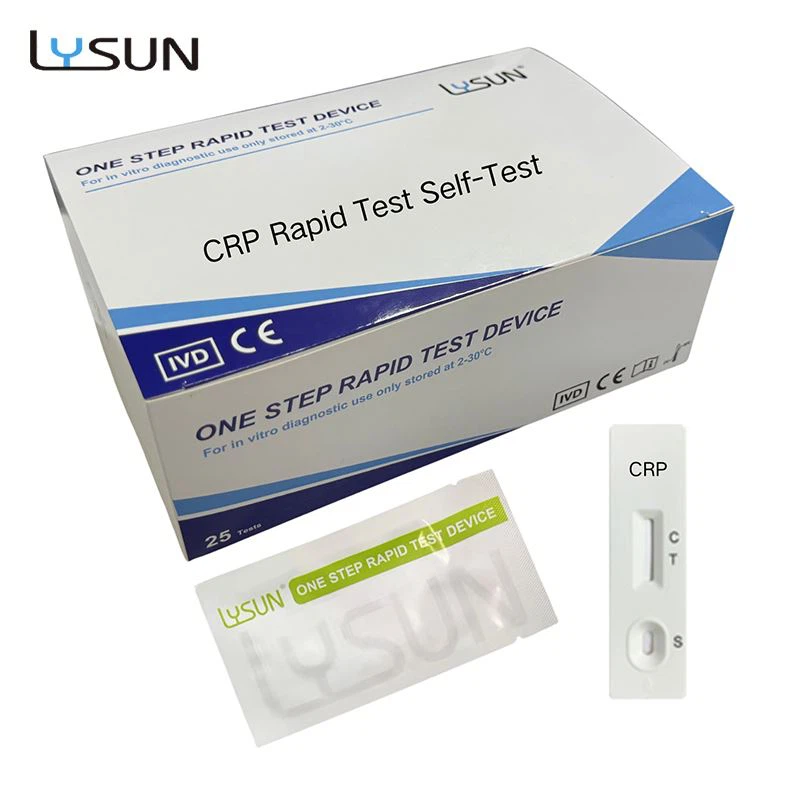
CRP Semi Quantitative Test in patient's sera has been found in association with acute infections, necrotic conditions and a variety of inflammatory disorders. There is a strong correlation between serum levels of CrP and the onset of the inflammatory process. Monitoring the levels of CrP in patient's sera indicates the effectiveness of treatment and the assessment of patient recovery. It is used in particular to differentiate bacterial infections from virus infections.


|
Product name |
C-Reactive Protein Semi-Quantitative Rapid Test Device |
|
Item type |
CRP-W21-3 |
|
Specimens |
Whole blood/Plasma/Serum |
|
Test Time |
Waiting about 15 minutes |
|
Certificate |
CE, ISO:13485 |
|
OEM |
Acceptable |
|
Storage condition |
The kit should be stored at 2-30°C |
SPECIMEN PREPARATION
1. Use a disposable pipette to transfer 10µL of the specimens and add to the dilution tube with buffer.

2. Bottom up and down the tube for several time to mix the specimens well.
The diluted sample can be kept at room temperature for at least 8 hours. EDTA, citrate or heparin blood can also be used as a sample.
QUALITY CONTROL
Internal procedural controls are included in the test. Reference band appearing in the reference regions is considered an internal positive procedural control, confirming sufficient specimen volume and correct procedural technique.
External controls are not supplied with this kit. It is recommended that positive and negative controls be tested as a good laboratory practice to confirm the test procedure and to verify proper test performance.
LITERATURE REFERENCES
1. Morley JJ, Kushner (1982) Serum C‐reactive protein levels in disease. In: Kushner I,
Volanakis JE, Gewurz H,eds. C‐reactive protein and the plasma protein response to tissue
injury. Ann. NY Acad. Sci. 389: 406‐417.
2. Peltola HO (1982) C‐reactive protein for rapid monitoring of infections of the central nervous system. Lancet:980‐983.
3. Macy EM, Hayes TE and Tracy RP (1997) Variability in the measurement of C‐reactive protein in healthy subjects: implications for reference intervals and epidemiological
FAQ
Q: What is a semi quantitative CRP test?
A: ACCU-TELL CRP Semi-Quantitative Rapid Test Cassette (Whole Blood/Serum/Plasma) is a rapid chromatographic immunoassay for the semi-quantitative detection of C-reactive protein in whole blood, serum or plasma. Allow test cassette, specimen, and/or controls to equilibrate to room temperature (15-30°C) prior to testing.
Q: What is a CRP blood test for pregnancy?
A: The C-reactive protein (CRP) test is a blood test that checks for inflammation in your body. CRP is a protein that is made in your liver and released into your bloodstream. When your body has inflammation, infection or tissue damage, CRP levels rise quickly, often within 24 to 48 hours.
Q: Should I be worried if my CRP is high?
A:Elevated CRP levels alone do not diagnose a specific disease, but they can indicate an increased disease risk that should be evaluated further by a healthcare provider. Common reasons for measuring hs-CRP include monitoring infections, assessing cardiovascular risk or diagnosing immune conditions.
Q: What will a doctor do if CRP is high?
A: If you're at a higher risk of developing a cardiovascular disease and your test results show high CRP levels, your physician may suggest some related medicines to lower the levels. Vitamin is one such component that smartly helps in reducing both the CRP levels and cardiovascular diseases.
Q: Is it good to have high CRP?
A: A high level of hs-CRP in the blood has been linked to an increased risk of heart attacks. Also, people who have had a heart attack are more likely to have another heart attack if they have a high hs-CRP level. But their risk goes down when their hs-CRP level is in the typical range.
Q: How do I prepare for a CRP test?
A: In general, there's nothing you have to do before this test, unless your doctor tells you to.
Q:What is the most common cause of high CRP?
A: The possible causes of increased CRP levels, or risk factors, are more often than not associated with other heart disease-related risk factors, including:
Having a sedentary lifestyle.
Obesity.
Smoking.
High blood pressure.
Metabolic syndrome.
Diabetes.
Q: What foods cause high CRP?
A: Diets high in dietary fiber and rich in fruits and vegetables are associated with lower CRP levels,20–23 while consumption of a Western diet, a diet high in fat, sugar, sodium, and refined grains, has been hypothesized to elevate CRP levels.
Hot Tags: crp semi quantitative test, China crp semi quantitative test manufacturers, suppliers, factory, C Reactive Protein Rapid Test Device, crp rapid test, C Reactive Protein Rapid Test, cardiac markers test


